03 · Research

Finding a gas giant around a small, cool star.

For my Matura thesis I characterised TOI‑7265.01, a Jupiter‑sized candidate transiting an M dwarf. The work combined my own ground based photometry from the Saint‑Ex observatory with TESS data and a 19‑dimensional MCMC joint fit. It received the top grade of 6.0 and is currently a finalist in Schweizer Jugend forscht (Swiss Youth in Science).

The question

Does TOI‑7265.01 exist, and what kind of planet is it?

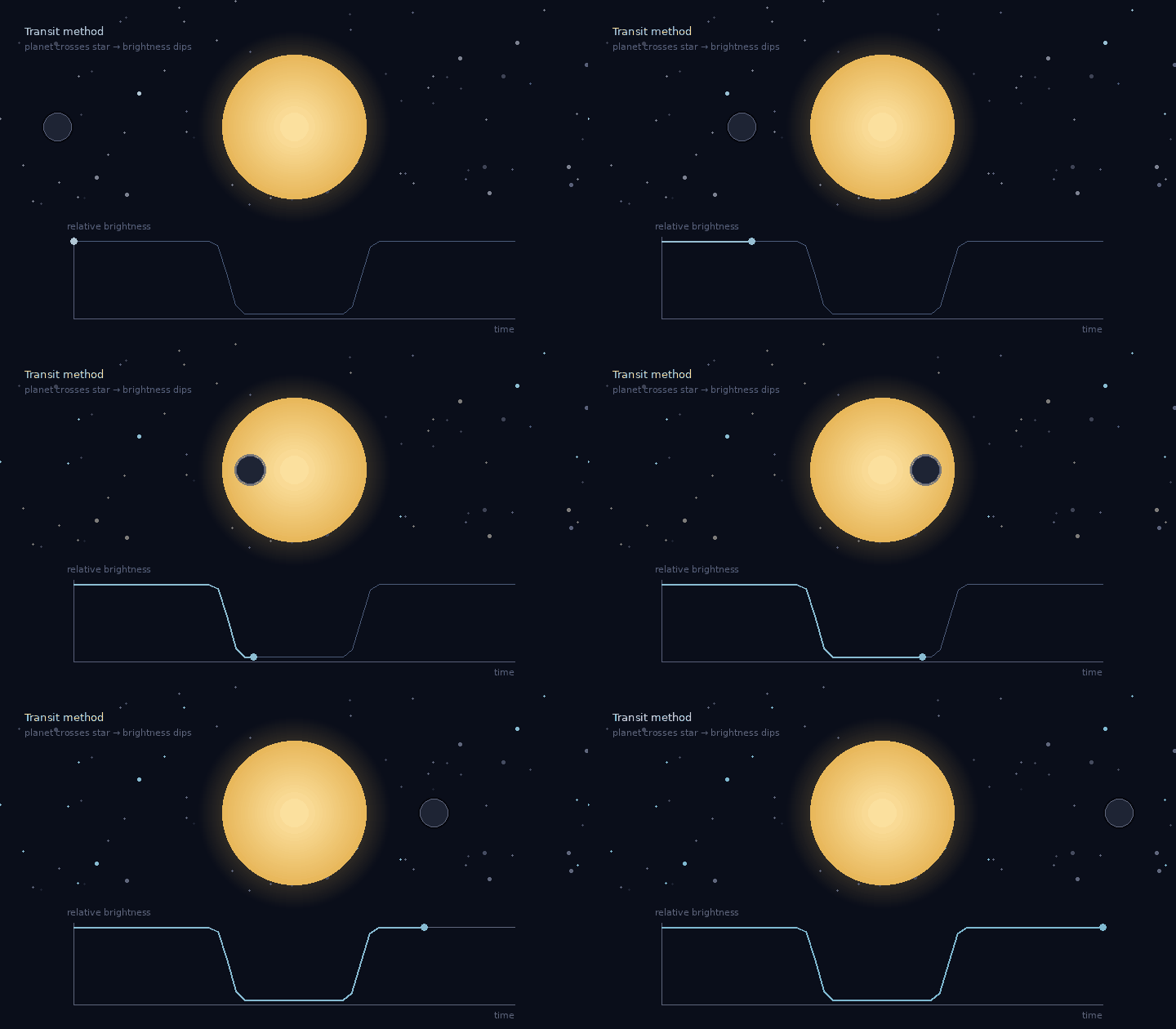
TESS flagged a periodic dip in the light from a small red star called TIC 275717567. The shape suggested something roughly the size of Jupiter passing in front of it every four days. Plausible, but TESS has a large pixel and picks up light from many stars at once. Without a closer look the signal could also be an eclipsing binary bleeding into the aperture, or an artefact of the instrument. My thesis was a closer look.

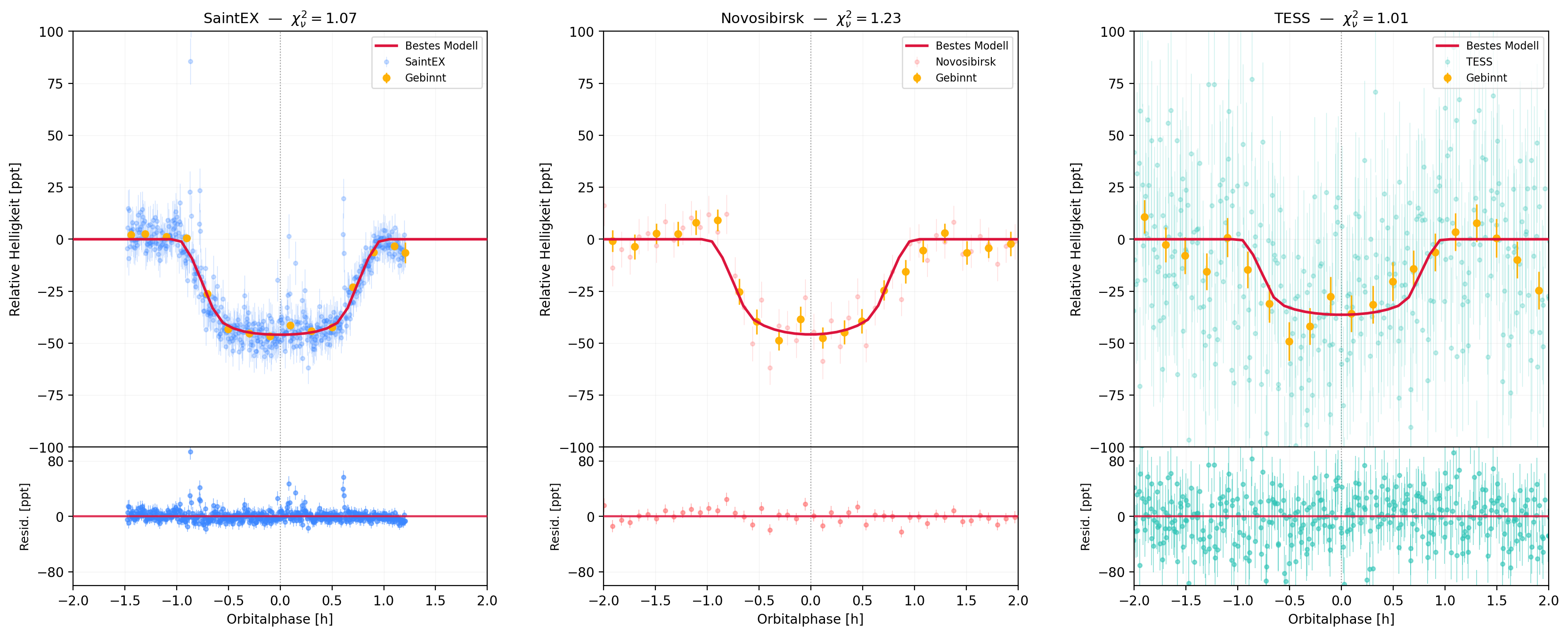
Phase folded transit light curve of TOI 7265.01 with residuals below
Phase folded transit of TOI‑7265.01 across all three instruments. The red curve is the best fit model from the joint MCMC. The flatness of the residuals below is the whole story.
Matura thesis · submitted March 2026

What we're looking at.

TOI‑7265.01 is a Jupiter‑sized candidate on a 4.17 day orbit around an M‑type dwarf (Teff ≈ 3392 K, 0.49 R, 0.49 M). Gas giants around small stars are rare, less than 1% of M‑dwarf systems, and they don't fit cleanly into the standard core‑accretion picture of planet formation. Each well characterised one is useful.

The goal of the thesis was to answer three questions. Is the signal real? What are its physical parameters? And given all of that, is it a plausible planet or a disguised false positive?

The data

Three telescopes, one planet.

A single transit from a single telescope is almost never enough. I worked with three independent sources, each with different noise, different pixel scales, and different bandpasses. If they all agree on the same planet, that agreement is the answer.

Saint‑Ex · 1 m

San Pedro Mártir, Mexico

Ground based photometry from the 1 m robotic telescope run by the University of Bern and the University of Liège. 534 data points across one full transit, observed for this thesis. This is the dataset I reduced myself in AstroImageJ.

Lyceum 130 · 0.28 m

Novosibirsk, Russia

A second ground based transit from an independent amateur observatory, contributed by collaborators. 62 data points. Same event, different sky, same dip.

TESS · space

NASA Transiting Exoplanet Survey Satellite

Two sectors of TESS photometry, 11 766 data points. Pre‑cleaned with the NuanceGP algorithm to remove stellar variability and instrumental systematics before the fit.

The method

A 19‑dimensional Bayesian fit.

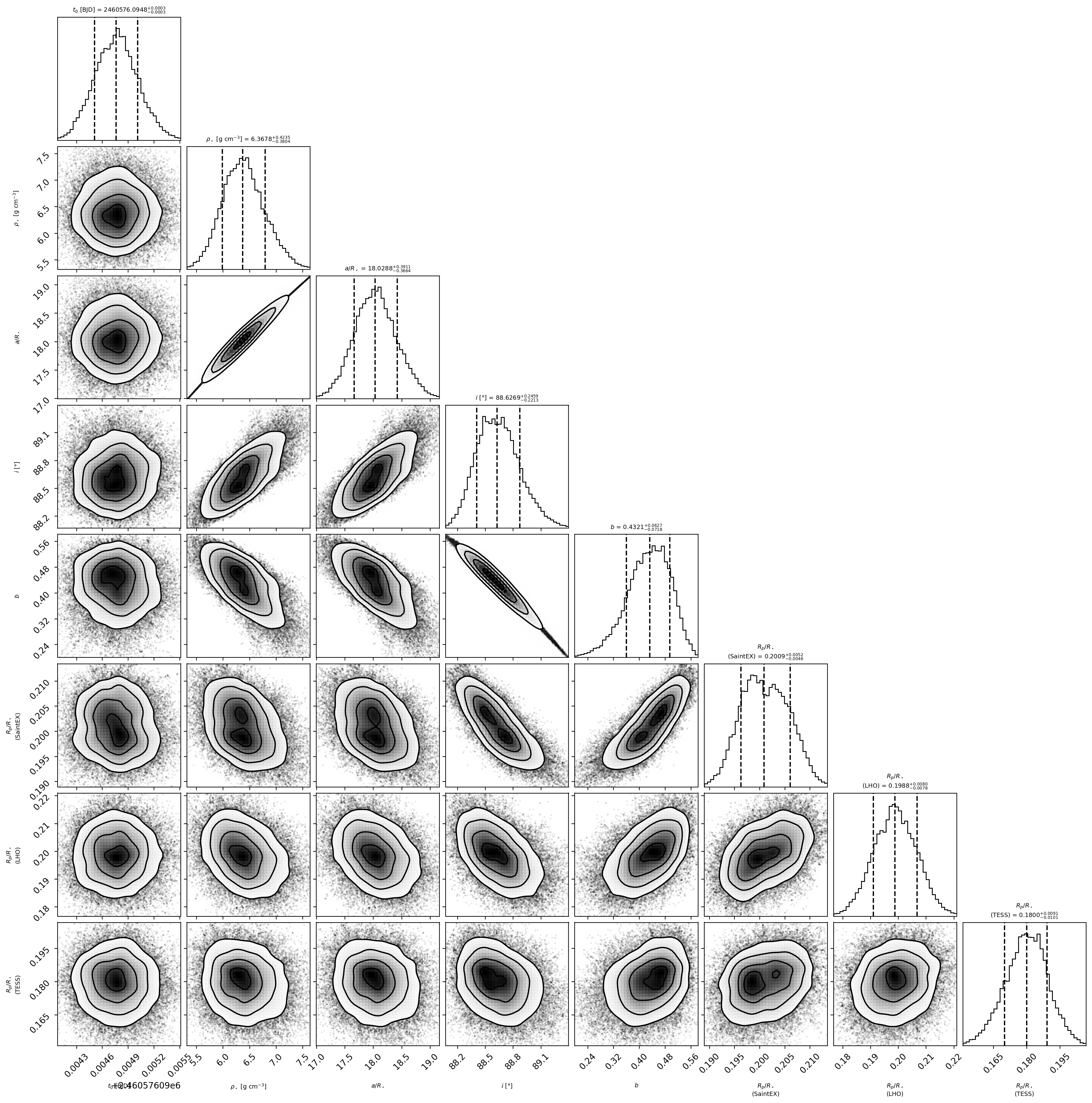
Every transit is a single shape with a handful of parameters, but fitting it honestly across three instruments means solving for orbital period, mid‑transit time, impact parameter, limb‑darkening, stellar density, and a separate radius ratio and pair of limb‑darkening coefficients for each telescope. Nineteen dimensions in total. The tool for that is Markov Chain Monte Carlo.

Step 1 · Observe and reduce

I planned the observation using the Swarthmore College Transit Finder and the TESS Follow‑up Program (ExoFOP) to pick a window where the full transit would be visible from Saint‑Ex above the airmass threshold.

The raw images from the 1 m telescope were calibrated against dark, flat, and bias frames in AstroImageJ to remove detector signatures. I then ran differential photometry, tracking the target star against a set of stable comparison stars in the same field to cancel out atmospheric transparency changes.

Step 2 · Model the transit

The forward model is batman (Kreidberg, 2015), an analytic implementation of the Mandel & Agol (2002) transit profile. It takes orbital and planetary parameters and returns the expected light curve for each observed time stamp.

Three reparametrisations make the sampling efficient:

  • Espinoza (2018) for impact parameter and radius ratio, sampling in (r1, r2) on a unit disk rather than in physically bounded (b, p).
  • Kipping (2013) for the quadratic limb‑darkening coefficients (q1, q2), so the prior is uniform on the physically allowed region.
  • Sozzetti et al. (2007) replacing a/R with the stellar density ρ, which is the same across all three transits by construction.

These aren't cosmetic. Without them the chains drift, get stuck, or sample regions that aren't physical. With them, the posteriors are almost Gaussian.

Step 3 · Run MCMC

The sampler is emcee (Foreman‑Mackey et al., 2013), an affine invariant ensemble sampler. 150 walkers, 50 000 steps, 65% burn‑in. The log‑likelihood is a Gaussian over the residuals of the three instruments, with each telescope carrying its own radius ratio and limb‑darkening pair to absorb wavelength and aperture effects.

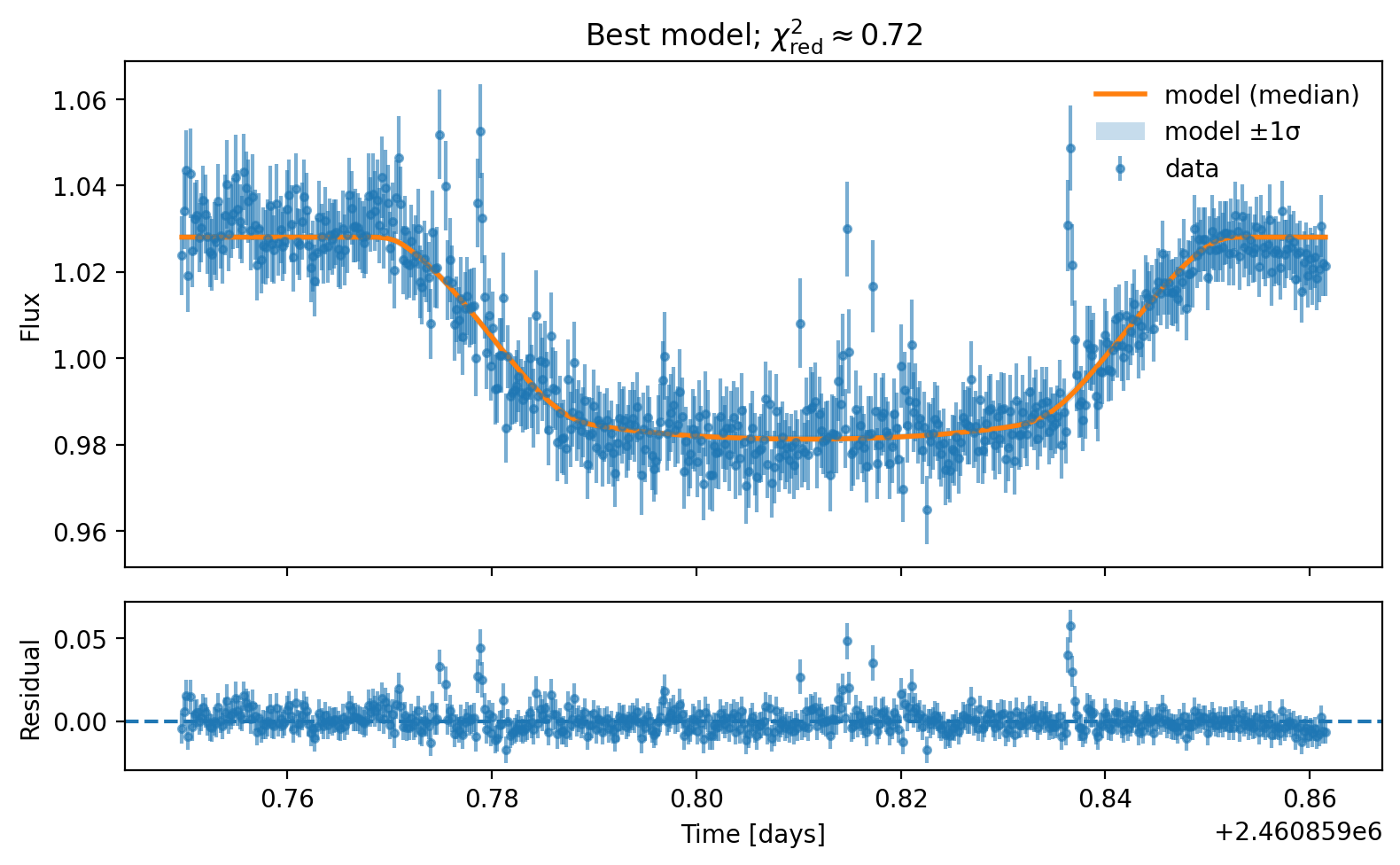
After burn‑in I checked convergence with integrated auto‑correlation time and walker acceptance. Reduced χ2 ranged from 1.01 to 1.23 across instruments, which is a healthy sign: not over‑fit, not under‑fit.

Step 4 · Validate

I ran TRICERATOPS, a standard statistical validator, on the TESS data. It returned a false positive probability of 0.987, which initially looked catastrophic. The reason turned out to be specific and explainable.

TESS has 21 arcsecond pixels. Inside the photometric aperture around TIC 275717567, the target star contributes only 4.3% of the total flux. The rest comes from contaminating neighbours. TRICERATOPS assumes the aperture flux is dominated by the target and therefore mis‑interprets the dilution as evidence for a blended binary.

The fix is the ground based data. At Saint‑Ex I could resolve the individual stars and place the dip cleanly on TIC 275717567. I also ran a neighbour eclipsing binary (NEB) check on the 271 stars within the aperture and ruled out 126 of them. That result, plus the consistency of the transit depth across instruments, argues convincingly that TRICERATOPS is simply the wrong tool for this system.
The answer

A warm Jupiter on a four day orbit.

Every instrument agrees. The parameters below are from the joint multi‑instrument fit, quoted as median ± 68% credible interval from the MCMC posteriors.

Orbital period:4.1723 ± 0.0001 d
Planet radius:0.938 ± 0.023 RJ
Impact parameter:0.30 ± 0.10
Stellar density:5.89 ± 0.47 g/cm³
Equilibrium temp.:565 ± 6 K
Mass (Chen & Kipping):0.5 – 1.5 MJ
Per‑instrument radius ratios
InstrumentRp/RNotes
Saint‑Ex0.201 ± 0.006Baseline, my photometry
Lyceum 1300.199 ± 0.008Consistent within 1σ
TESS0.180 ± 0.004Slightly shallower, consistent with 4.3% target flux dilution

The small drop in the TESS value is not a disagreement. It is exactly what you expect when neighbouring stars dilute the aperture flux: the fractional dip gets smaller. Corrected for dilution, all three agree.

So is it a planet?

Given the converging evidence: matching transit depths across three independent instruments, a clean resolved detection at Saint‑Ex that rules out the contaminating aperture problem, a radius consistent with a warm Jupiter, and chi‑squared near 1.0 across the board, I classify TOI‑7265.01 as a robust planetary candidate.

Confirmation in the strict sense would require a radial velocity follow‑up. Assuming the mass estimate from the Chen & Kipping (2017) relation, the expected RV semi‑amplitude is roughly K ≈ 100–300 m/s, which is easily within reach of modern spectrographs like HARPS or MAROON‑X. That is the natural next step.

Why this matters

Jupiter‑sized planets around M‑type stars are rare. Their host stars are small and cool, so standard core‑accretion models struggle to grow a gas giant in their protoplanetary disks within the available time. Every confirmed example is a constraint on planet formation theory.

TOI‑7265.01 adds one more. Its mass, once measured, will feed directly into the question of how massive cores can form around low‑mass stars, and under what disk conditions gas accretion can run to completion there.

Read the full thesis

The complete thesis is 90 pages, in German, with derivations, corner plots, appendix code, and a full reference list.

Open the thesis (PDF) ↗

Where this fits.

A few adjacent pieces of work that fed into the thesis.

CSH · University of Bern

CHEESE research group

Since November 2025 I've been a part‑time research intern with the group, supervised by Prof. Brice‑Olivier Demory and doctoral student Francis Zong Lang, working on validation of Jupiter‑sized planets around M dwarfs.

ETH Zürich · June 2024

Kepler data and TrES‑2b

Selected participant at the ETH Zürich Physics Study Week. Re‑derived transit parameters for TrES‑2b from Kepler data as a training exercise on the same method.

Swiss Olympiads

Physics and mathematics

Competitor in the Swiss Physics and Mathematics Olympiads. Since November 2025 I volunteer with the Swiss Astronomy Olympiad.

← Back About Next → Quant